


The marketing world faces a fundamental question: What’s the best way to target audiences? With media platforms offering native audience options and a vast third-party data marketplace available, marketers must choose between two fundamentally different approaches.
The Strategic Dilemma
Picture this scenario: You’re planning a major campaign launch. Your media team presents two paths forward:
Path A (Segment & Target): Select a few carefully curated third-party audiences and target them consistently throughout your campaign.
Path B (Experiment): Test many platform audiences and optimize to the best performing ones during the campaign.
Platform audiences are cheaper and likely more accurate, but they don’t always fit brand needs, like targeting category buyers with Facebook interest audiences. Third-party audiences are more tailored to brand requirements but typically cost more due to CPM premiums.
Most marketers would instinctively choose the precision of Path A. But what if this intuition is wrong?
The Simulation That Settled the Debate
Rather than rely on expensive trial-and-error campaigns, I used Monte Carlo simulation to run 100,000 virtual campaigns comparing these approaches. Here’s exactly how I set it up:
The Experimental Approach
Audiences: Platform-specific (Meta, Google, Amazon)
Cost: $5 CPM
Reach: 0.5M – 5M audience sizes
Performance: 1-3% conversion rates
Strategy: Start with 20 audiences for 2 weeks, optimize to top 10 for next 4 weeks, then top 5 for final 6 weeks
The Segment & Target Approach
Audiences: Third-party data audiences
Cost: $7 CPM ($2 premium)
Reach: 0.65M – 6.5M audience sizes
Performance: 1.2-3.6% conversion rates (20% performance premium)
Strategy: 5 audiences for the full 12 weeks
The Shocking Results
After 100,000 campaign simulations, the first result was almost anticlimactic:
Average Performance: Nearly Identical
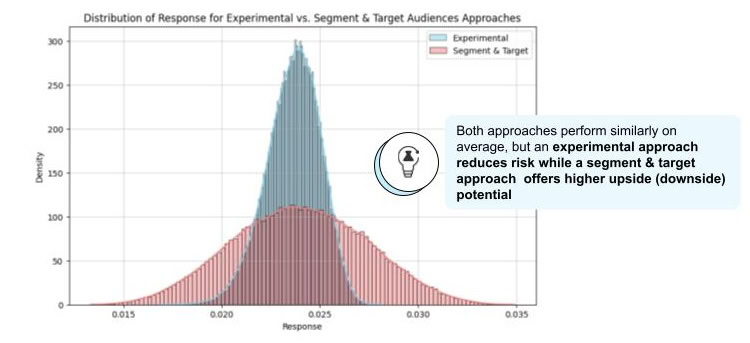
Experimental Approach: $1.5M spend, 302M impressions, 0.023638% response rate
Segment & Target: $1.5M spend, 214M impressions, 0.023970% response rate
The difference was so small it’s essentially meaningless.
But when I examined the distribution of results, a stunning pattern emerged that changes everything we think we know about audience strategy.
The Hidden Truth About Risk
While average performance was nearly identical, the risk profiles were dramatically different:
The Segment & Target approach created a dangerous feast-or-famine scenario. The distribution showed it could deliver exceptional results on the high end, but also catastrophic failures on the low end. You’re making a high-stakes bet on just 5 audiences carrying your entire campaign.
The Experimental approach delivered something more valuable: consistent, predictable performance. By optimizing from a broader pool of 20 starting audiences, it virtually eliminated the risk of terrible results while maintaining strong averages.
The Counterintuitive Discovery
Here’s what challenges everything we believe about audience targeting: The approach that seems more controlled and scientific (segment & target) is actually the higher-risk strategy.
The experimental approach reduces risk by selecting from a broad pool of audiences throughout the campaign. You’re unlikely to get exceptional performance, but you’re also unlikely to fail catastrophically.
The segment & target approach offers higher upside potential, but with significantly higher downside risk. All 5 audiences could perform exceptionally well, or they could all underperform drastically.
What This Means for Your Strategy
The simulation reveals a fundamental truth: Both approaches perform similarly on average, but an experimental approach reduces risk while a segment & target approach offers higher upside and downside potential.
This insight forces a critical question: How much do you want to gamble with your audience strategy?
For the experimental approach, you need to be confident that your optimization process can effectively identify and scale the best-performing audiences from your initial test pool.
For segment & target, you need to be confident that your third-party data will deliver at least 20% better performance than platform audiences to justify the cost premium, and you need to be prepared for the possibility of significant campaign underperformance.
The Bottom Line
After 100,000 simulated campaigns, the data tells a clear story: The experimental approach isn’t just a viable alternative, it’s often the superior choice for risk management.
The question isn’t which approach delivers better performance (they’re essentially equal on average). The question is whether you’re optimizing for predictable results or willing to accept higher variance for the chance of exceptional outcomes.
The approach that feels safer might actually be the riskier bet.
Real Intelligence in Action
This simulation study exemplifies what we call Real Intelligence, the approach that sits at the core of our media operating system. We use it to develop a real understanding of real customers, influence real action, and deliver measurable, real business outcomes.
We start from a place of first principles, which means separating signals from noise to draw conclusions from real data, not assumptions. Rather than accepting conventional wisdom about audience targeting, we continuously test hypotheses to inform bigger strategic decisions, in this case, our entire audience strategy.
By running 100,000 simulations, we discovered that our industry’s assumptions about risk and precision were backwards. This is Real Intelligence at work: using data to challenge what we think we know, then building strategies based on what we actually know to be proven.